Benchmarking AI for Industrial Use: Right Answers, Fast, at the Right Cost
CVector benchmarks AI models for industrial use, revealing how model choice and settings shape answer quality, speed, and cost.
.png)
Summary
An operator investigating an alarm needs an answer they can check and use while there is still time to act. A clear conclusion, with evidence and limits, helps the team decide what to do next.
Across our critical infrastructure deployments, we’ve learned that matching the right model to the task is essential to delivering reliable business value and capturing opportunities to improve margins. This benchmark compares accuracy, speed, and cost for frequent questions in alarm troubleshooting and outage analysis.
In the reported results, GPT-5.4 with CVector’s agent harness had the highest pass rate: 96.8%, with a 19.3-second median response time at $0.371 per case. Several newer configurations took longer, cost six to seven times as much, and passed fewer cases.
The questions behind the benchmark
Most people encounter large language models, or LLMs, through tools like ChatGPT. In CVector, they help operators and engineers find answers in plant data and engineering documents.
CVector’s agent harness gives the model the context and tools to retrieve information and compose a response. We evaluate models inside that workflow to find the right combination of answer quality, speed, and cost.
Consider three questions that can come up during a shift:
- An operator investigating an alarm: What changed in the process, and what does the operating procedure say to check? The answer should connect recent signals to the procedure and help identify the next check.
- An engineer reviewing an outage: Which alarms and process changes preceded the equipment trip? A timeline grounded in alarm history and operating data helps narrow the investigation.
- A maintenance planner investigating fouling: How does performance compare with the equipment’s design basis and its last cleaning? The comparison helps the planner assess whether further investigation or cleaning is warranted.
Accuracy helps the team choose its next step, speed keeps the investigation moving, and an affordable cost makes that support practical for routine questions across shifts and sites.
What we tested
Our test cases and data are synthetic, but built around real questions and daily challenges faced by energy and industrial operators at the sites we serve. We evaluate the workflow from retrieving evidence to delivering an answer.
An answer may combine stored process measurements, lab results, maintenance records, and equipment datasheets. Choosing the wrong sensor, overlooking a data-quality flag, or mixing units can produce a convincing but wrong conclusion.
A judge model scores responses against reference answers and a rubric covering the numbers, sources, and necessary caveats. An answer must acknowledge when the evidence is insufficient.
We compare pass rate against that rubric, median response time for the complete workflow, and cost per case: how often an answer meets the standard, how long the user waits, and what repeated use costs.
What we found
The results show newer isn't better.
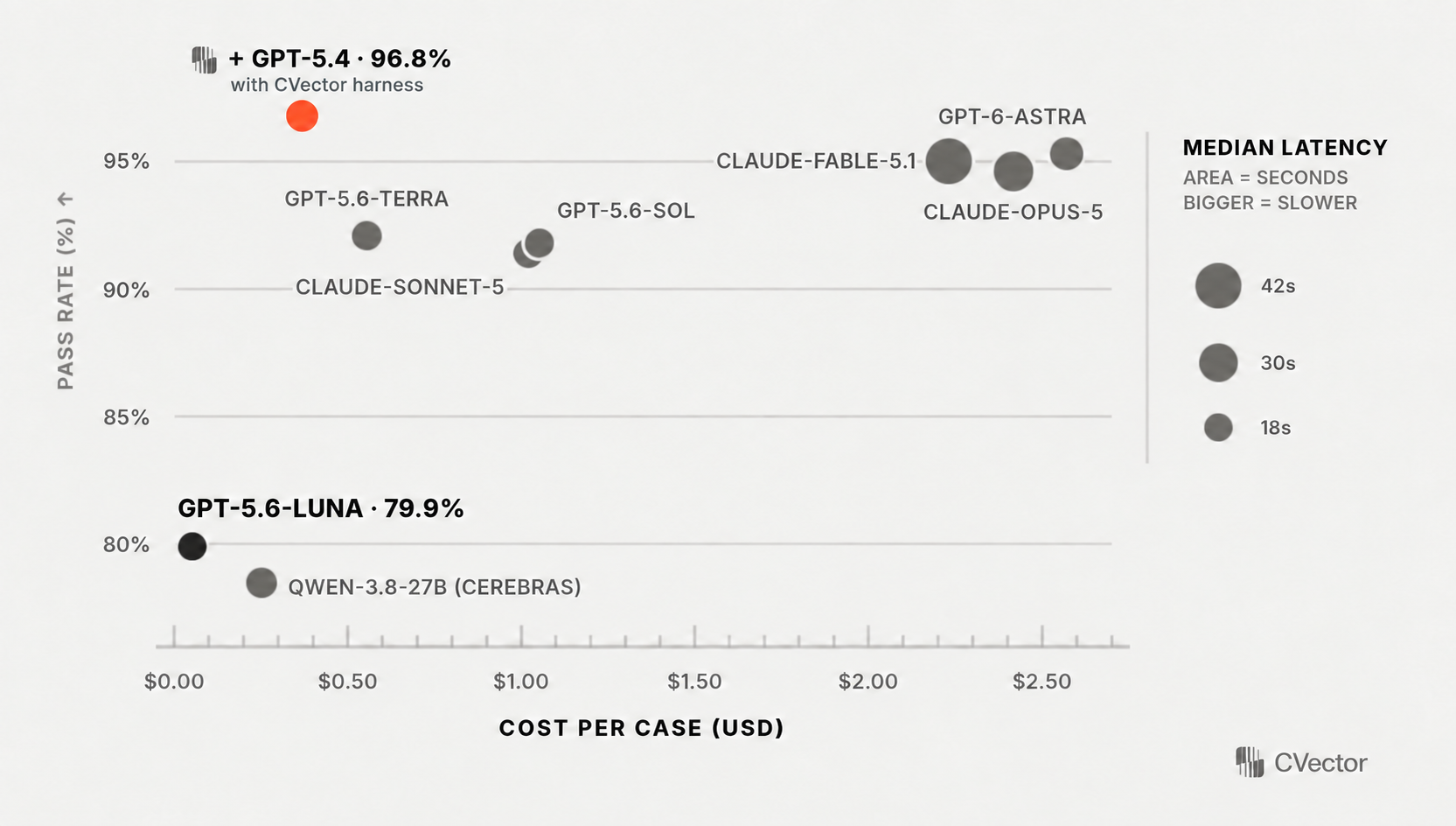
Higher points have higher pass rates; points farther left cost less per case; smaller circles indicate shorter median response times. The highlighted result is GPT-5.4 with CVector’s harness. The chart and table summarize nine selected configurations.
“Low” and “none” are reasoning settings; “fast” means the model provider’s fast mode. The engineering results include configurations marked as estimated, including GPT-5.4 in fast mode. Results apply to the listed settings and this workflow.
GPT-5.4 combined the highest pass rate with practical speed and cost. Its reported cost per case is about 86% below GPT-6 Astra, with a median response 3.9 seconds sooner. That cost difference matters with repeated use.
Speed only helps when the answer is usable. Qwen on Cerebras returned responses in a median of 20.0 seconds, but passed 78.5% of cases. We evaluate response time alongside answer quality.
The settings are part of the choice. Luna’s pass rate rises from 79.9% with no reasoning effort to about 95% at medium or high effort. That changes its cost and response time, which is why we evaluate configurations as well as model names.
For the operator facing an alarm, those choices should translate into an answer they can verify and use without unnecessary waiting.
A closer look at models and settings
The broader results show why model selection also means choosing the right reasoning effort and provider mode.
Pass rate by model and reasoning effort
More reasoning effort does not consistently improve the result. Luna is listed at about 80% with no reasoning effort and about 95% at medium or high effort; its maximum-effort setting is lower. The useful choice depends on the configuration and task.
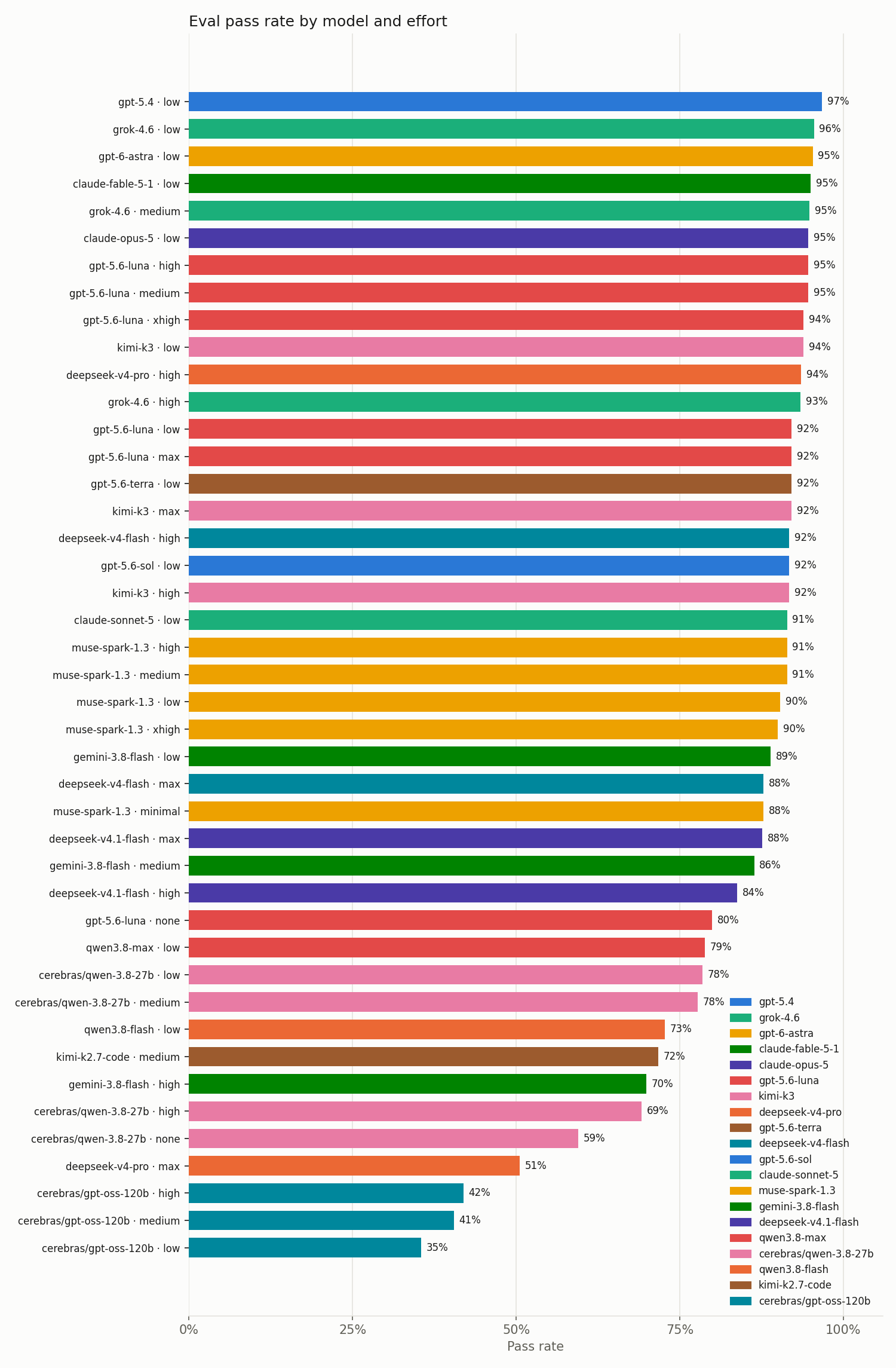
Each bar is a model-and-effort combination. Labels are rounded to whole percentages, so GPT-5.4’s 96.8% appears as 97%.
Cost versus pass rate: standard and fast modes
Similar pass rates can come at very different costs. This chart compares model and reasoning configurations in standard mode and the provider’s fast mode.
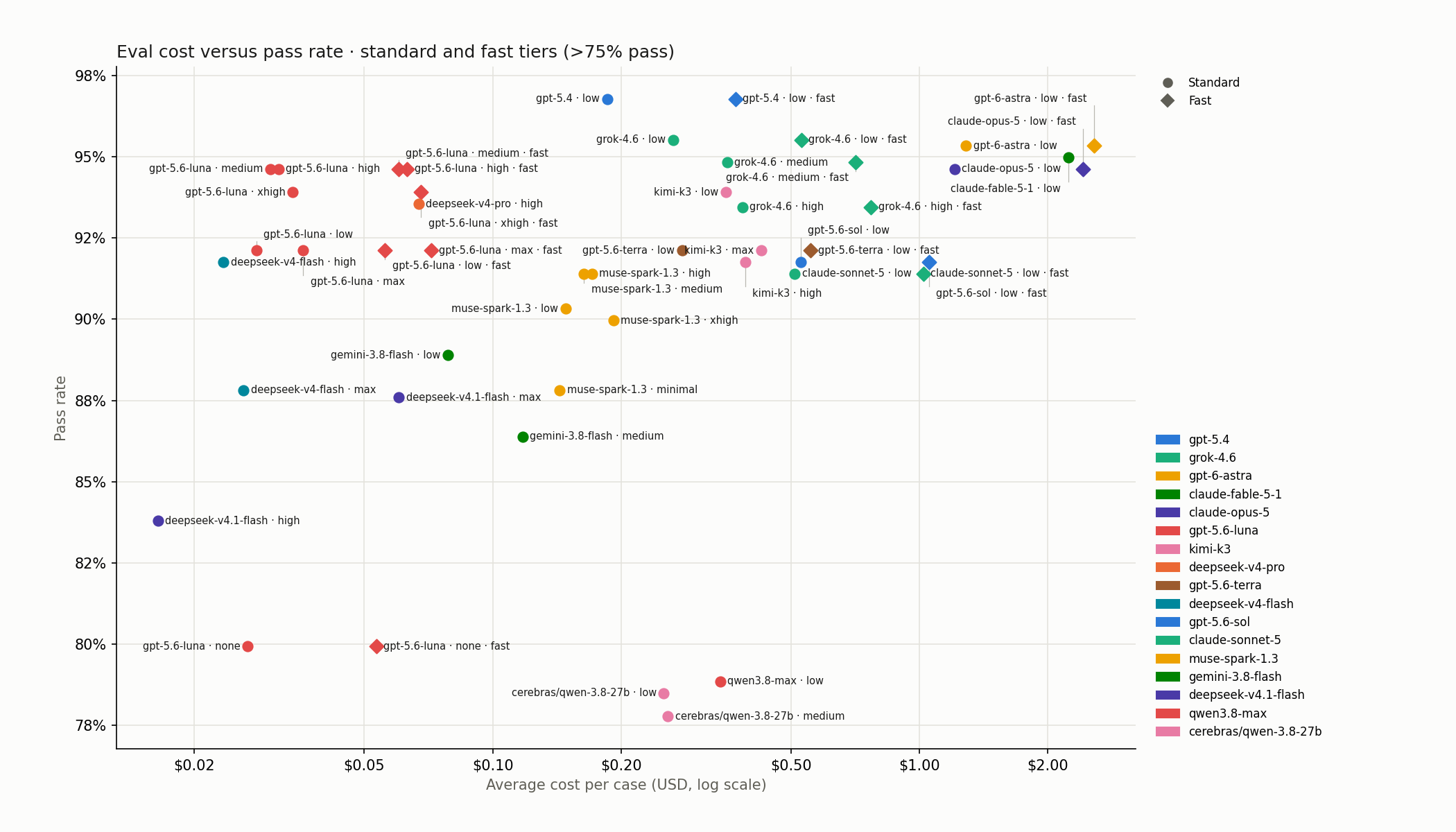
Only configurations with pass rates above 75% are shown. The cost axis is logarithmic. Circles indicate standard mode; diamonds indicate the provider’s fast mode. Response time is not plotted here; the source includes estimated configurations.
The best model for each job
This is part of CVector’s ongoing benchmark series and how we improve our product. We test models and harnesses against the accuracy, speed, and cost requirements of the work our customers need done.
Long-running scenario modeling, plant economics, and complex optimization may justify deeper analysis and a longer wait. We evaluate those workflows separately, including how well an agent calibrates models, runs analyses, and delivers results.
Want to collaborate on industrial test cases? Interested in CVector’s benchmarks for long-running, complex scenario modeling? Reach out at info@cvector.com. Let’s compare notes.
As model intelligence becomes more widely available, industrial data foundations must support many agents working at once, alongside people. Our next engineering post explores how we’re building CVector’s data foundation for that workload. Stay tuned.
.avif)